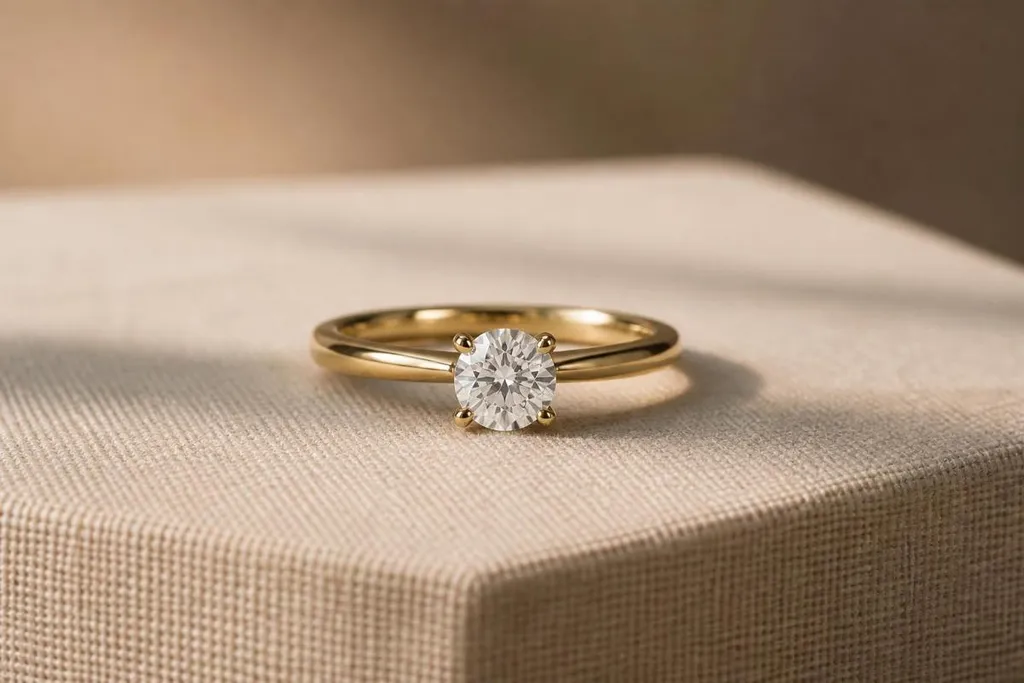
The enduring appeal of a solitaire engagement ring lies in its restraint. With one centre stone and a clean band, there is nowhere for a poor proportion to hide—but there is also considerable scope for thoughtful refinement. The width, profile and presence of the band can subtly change how substantial the centre stone appears and how the ring feels on the hand. For this reason, tailoring the band can be just as important as choosing the diamond itself.
For someone who likes the simplicity of a solitaire but wants to adjust its proportions, this upgrade provides a way to refine the band while preserving the defining simplicity of the design. Rather than introducing extra stones or decorative detailing, the emphasis remains on proportion, balance and the relationship between the shank and centre setting.
Why Band Proportion Matters in a Solitaire
A solitaire is visually simple, which makes each individual component more noticeable.
A very fine band can make the centre diamond appear relatively prominent because there is less metal competing for attention. This creates the delicate, centre-focused appearance often associated with contemporary solitaire rings.
A more substantial band changes that relationship. Instead of visually disappearing beneath the diamond, the shank becomes a stronger part of the composition. This can give the ring a more grounded, traditional or architectural presence depending on its exact profile.
Neither approach is inherently more elegant. The right proportion depends on the stone, finger and wearer's preferences.
A person who enjoys understated jewellery may prefer a slim band even with a larger diamond. Another wearer might choose additional band presence because they want the ring to feel substantial across the whole finger rather than concentrating all visual weight at the centre.
Matching the Band to the Centre Stone
Centre-stone size is one of the most useful considerations when refining a solitaire band.
A 1-carat diamond paired with a relatively fine shank can create a balanced, delicate effect. Increasing the centre to 2 carats changes the visual scale considerably, and some wearers may prefer a more substantial band to provide greater proportional balance.
The reason for choosing a wider or more defined band is not simply that a larger diamond "needs" more metal. It is about how the ring feels as a complete object. A prominent centre on an extremely delicate shank creates intentional contrast; a stronger band produces a more unified sense of scale.
Diamond shape matters too. Elongated ovals, pears and marquise cuts already create significant finger coverage, while round stones concentrate their visual mass more centrally. Emerald and radiant cuts introduce strong geometry that can pair particularly well with a clean, structured shank.
Looking at the band and stone together is therefore more useful than selecting either according to measurements alone.
Creating a Tailored Look Through Metal and Profile
Band dimensions are only part of the equation. Metal colour and surface shape also affect the finished appearance.
Platinum and white gold can create a crisp, cohesive setting around a colourless centre stone. Yellow gold introduces warmth and stronger contrast, allowing the band to remain visually distinct from the diamond. Rose gold produces a softer effect and can make an otherwise minimal solitaire feel more romantic.
The profile influences character in a similarly subtle way. A softly rounded band has a traditional fluidity, while cleaner edges can make the ring feel more contemporary.
These decisions are especially important when the design intentionally avoids pavé or elaborate shoulders. In a classic solitaire, the quality and proportions of the metalwork are not background details; they are central to the overall aesthetic.
A carefully tailored band should support the centre stone without making the ring unnecessarily complicated.
Consider Comfort and the Wedding Band
An engagement ring is viewed from above, but it is experienced from every angle during daily wear. Comfort therefore deserves equal attention.
A more substantial band may feel reassuring to someone accustomed to heavier jewellery, while another wearer may prefer the barely-there sensation of a finer shank. Finger size and the shape of neighbouring fingers can also influence what feels natural.
The future wedding band should be considered at the same time. A stronger solitaire band may pair beautifully with a similarly proportioned plain wedding ring, creating a clean and coordinated set. A delicate wedding band can instead provide intentional contrast.
Metal choice, width and profile do not necessarily have to match exactly, but the two rings should feel visually connected when worn together.
Long-term practicality matters as well. Routine professional inspections and sensible care help maintain the setting and finish, particularly for a ring worn every day.
Final Thought
A classic solitaire does not need additional decoration to feel personal. Adjusting the band can change its proportions, visual weight and relationship with the centre stone while preserving everything that makes solitaire design timeless.
The most successful upgrade is one that responds to the wearer's hand, diamond choice and everyday preferences. By treating the band as an important design element rather than simply a support for the stone, a familiar solitaire can become noticeably more tailored and individual.